Assessed Value vs Market Value in New Hampshire
The number on a New Hampshire tax bill is the assessed value, not what the house would sell for. Towns must reappraise at full and true value at least every 5 years (RSA 75:8-a), but between revaluations prices move and assessments do not. The state measures the gap every year with the equalization ratio.
What the ratio is
The DRA runs a sales-assessment ratio study each year and calculates a weighted mean ratio to one-tenth of one percent; equalization is "the process by which adjustments are made to each municipality's locally assessed values to calculate the estimated market value." A ratio of 1.00 (100%) means assessments match sale prices on average; 0.80 means they sit at about 80% of market value; above 1.00, above it.
Keene publishes its own: the DRA's 2024 ratio for the city was 66.8%. So a Keene house assessed at $250,000 implies a market value of about $374,251, and Keene's $33.07 2024 rate on assessed value is about $22.09 on market value.
How the appeal board uses it
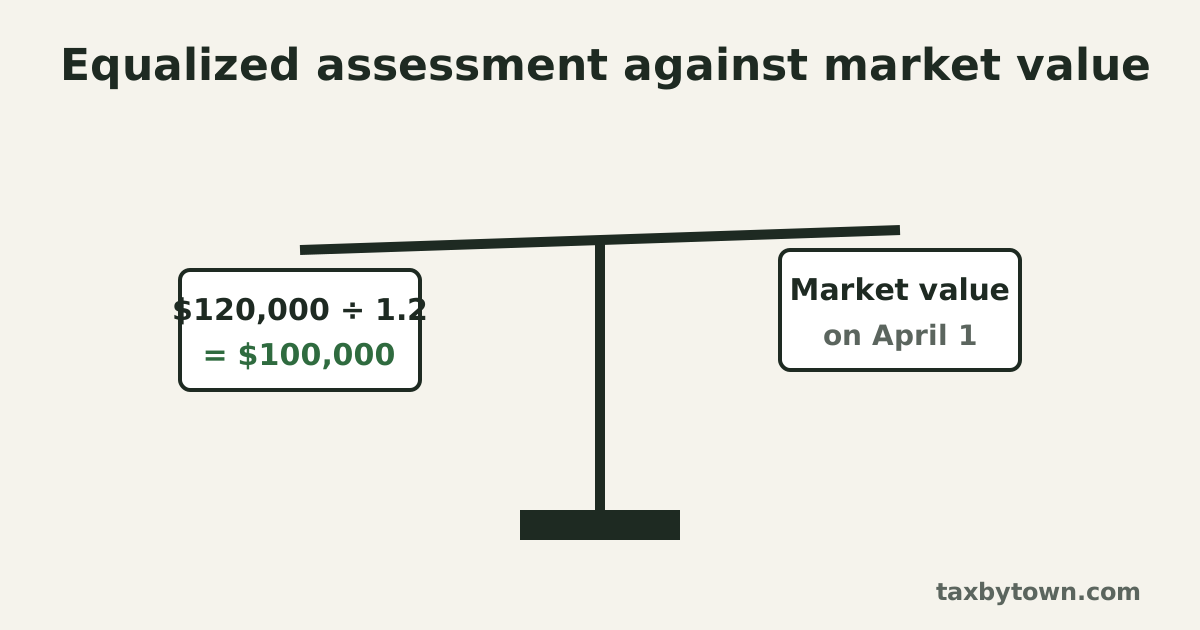
The Board of Tax and Land Appeals divides the assessment by the ratio to get the equalized assessment, then compares it with the property's market value on April 1. Its own example: An assessment of $120,000 with a ratio of 1.20 gives an equalized assessment of $100,000; the question is whether the property was worth $100,000 on April 1.
| Assessment | Ratio | Equalized assessment | Market value | Equalized vs market |
|---|---|---|---|---|
| $120,000 | 1.2 | $100,000 | $100,000 | equal |
| $300,000 | 0.75 | $400,000 | $360,000 | $40,000 above |
| $300,000 | 0.75 | $400,000 | $450,000 | $50,000 below |
The second and third rows are illustrations computed with the site's engine. An assessment can look low against market value and still be disproportionate, if the town's ratio is lower still; the equalized figure is what puts every owner on the same footing. The appeal check runs this division and the appeal page sets out the procedure.
Why rates mislead between towns
A town assessing at 70% needs a higher rate to raise the same tax as a town at 100%. Rates on this site are the DRA's rates on each town's assessed value, so two towns with similar rates can have different bills on the same house. The ratio is the correction, and it is published by the DRA for every town; each town page points to it.
Sources
- N.H. Code of Admin. Rules, Chapter Rev 2800 (Equalization), read 2026-10-20.
- BTLA, Commonly Asked Questions (property tax).
- City of Keene, Tax Rate Information, read 2026-10-20.
- RSA 75:8-a, Assessment.
Questions
What is an equalization ratio?
The Department of Revenue Administration's measure of how a town's assessments compare with sale prices, from a yearly sales study. A ratio of 1.00 means assessments match market value on average.
How does the appeal board use it?
It divides the assessment by the ratio and compares that with market value on April 1. Its example: An assessment of $120,000 with a ratio of 1.20 gives an equalized assessment of $100,000; the question is whether the property was worth $100,000 on April 1.