Maine Property Tax Commitment, Explained
A Maine town's tax commitment is the moment its property tax becomes collectable. The assessors finish valuing every property, apply the mil rate, sign the list of what each owner owes and hand it, with a warrant, to the tax collector. The total of that list is the commitment: for the 2024 tax year the 482 municipalities that file a valuation return committed $3,412,323,170 between them.
What the statute says
The assessors "shall assess upon the estates in their municipality all municipal taxes" together with the municipality's share of any county or state tax, then "make perfect lists of those estates and commit the same", signed by a majority of the assessors, to the municipal tax collector with a warrant in the form set by § 753. Where there is no collector the lists go to the sheriff. (36 M.R.S. § 709)
Two things follow. The commitment is the assessors' act, not the collector's: Maine Revenue Services' Bulletin 10 notes that tax collectors cannot grant abatements, so a request to reduce a committed tax goes to the assessors. And the committed total includes the municipality's share of the county tax as well as its own.
Who sets the date
There is no single statewide commitment date. Each municipality, at the meeting that raises the tax or a later one before commitment, votes:
| What the town votes | Source |
|---|---|
| Tax year: "The taxable year is from April 1st to March 31st", and taxable property is fixed as of April 1. | 36 M.R.S. § 502 |
| Commitment and due dates: Each municipality "by vote" sets the date the assessors' lists are committed to the tax collector and "the date or dates when property taxes shall become due and payable", so one town may bill once and its neighbour twice or four times a year. | 36 M.R.S. § 505(1), (2) |
| Late interest: The town votes the interest rate on delinquent tax, up to the Treasurer of State's maximum: "For taxable year 2026, the maximum interest rate that a municipality may charge for delinquent property taxes is 7.0%" (down from 7.5%). | 36 M.R.S. § 505(4); Maine Treasurer, January 9, 2026 |
So two neighbouring towns can commit weeks apart and bill on different schedules. The town's own tax collector publishes its dates.
Why the date matters to owners
The commitment date matters to owners because a written abatement request must be "filed within 185 days from commitment" (36 M.R.S. § 841(1)), and it goes to the assessors: Maine Revenue Services' Bulletin 10 notes that tax collectors cannot grant abatements. The steps after that are:
| Step | Deadline | Source |
|---|---|---|
| Written abatement request to the assessors | 185 days after commitment | 36 M.R.S. §§ 841–849 (Bulletin 10) |
| Assessors' decision | 60 days | 36 M.R.S. §§ 841–849 (Bulletin 10) |
| Appeal to the Board of Assessment Review or county commissioners | 60 days | 36 M.R.S. §§ 841–849 (Bulletin 10) |
| Appeal to the Superior Court | 30 days | Bulletin 10; M.R. Civ. P. 80B |
A town that commits on, say, September 1 starts that 185-day clock on September 1, not on the day the bill arrives. The Maine appeal page has each step with its source.
The largest commitments in 2024
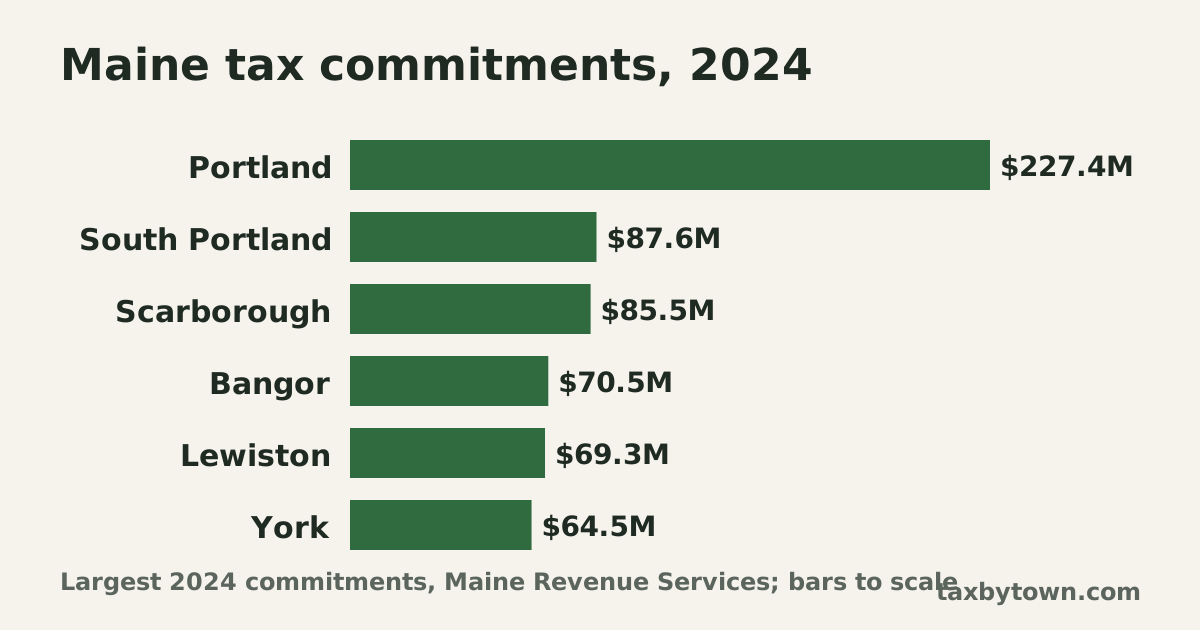
Maine Revenue Services publishes each municipality's commitment in its Municipal Valuation Return statistical summary. The ten largest for 2024:
| Municipality | County | Commitment | Mil rate |
|---|---|---|---|
| Portland | Cumberland | $227,390,909 | $15.01 |
| South Portland | Cumberland | $87,577,290 | $13.20 |
| Scarborough | Cumberland | $85,488,485 | $10.93 |
| Bangor | Penobscot | $70,455,764 | $18.55 |
| Lewiston | Androscoggin | $69,289,125 | $31.77 |
| York | York | $64,507,163 | $8.40 |
| Brunswick | Cumberland | $63,682,747 | $23.85 |
| Biddeford | York | $60,564,065 | $14.22 |
| Falmouth | Cumberland | $56,104,198 | $13.38 |
| Saco | York | $55,334,222 | $14.05 |
Every municipality's figure is on its own page, under "tax commitment", with the rate, ratio and valuation behind it; the Maine rates page ranks all 482. The commitment divided by the taxable valuation gives back the mil rate, which is how the site checks each row.
Sources
- 36 M.R.S. § 709, Assessment and commitment, read October 25, 2026
- 36 M.R.S. § 505, Taxes; payment; powers of municipalities, read October 25, 2026
- 36 M.R.S. § 502, Property taxable; tax year, read October 25, 2026
- Maine Treasurer of State, Treasurer Perry Reduces Interest Rate on Delinquent Property Taxes (January 9, 2026), read October 25, 2026
- Maine Revenue Services, 2024 Municipal Valuation Return Statistical Summary, Section 1 (certified ratio, commitment, tax rate, total taxable valuation), dated November 19, 2025
- Maine Revenue Services, Property Tax Bulletin No. 10 (revised March 26, 2020)
This guide explains published rules and figures; it is not tax or legal advice.
Questions
What is a tax commitment in Maine?
The assessors' signed list of every owner's tax, delivered with a warrant to the tax collector (36 M.R.S. § 709). Its total is the town's commitment; Maine's 482 reporting municipalities committed $3,412,323,170 for 2024.
When does a Maine town commit its taxes?
On a date the town votes (36 M.R.S. § 505(1), (2)); there is no statewide date. The tax year runs April 1 to March 31 (36 M.R.S. § 502).
Why does the commitment date matter?
A written abatement request must be filed within 185 days from commitment (36 M.R.S. § 841(1)). It goes to the assessors; Maine Revenue Services' Bulletin 10 notes that tax collectors cannot grant abatements.